
The following chapters are dedicated to the setup elements as they appear on the device in the English language. For this reason, these elements are translated only in the table of contents and not in the headings or selection lists in the chapters that describe the setup.
MC
0.5 m/s
Here, the MacCready value (MC) can be set from 0.0 to 9.9 m/s in increments of 0.1 m/s. After confirming with a short press, the variometer immediately returns to normal operation.
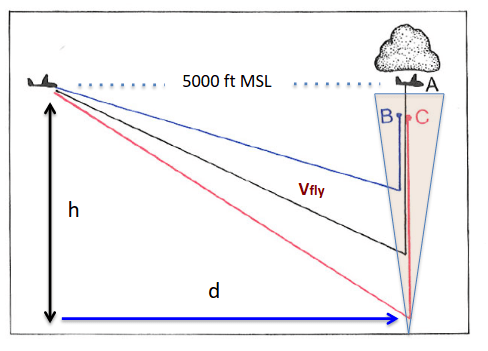
The MC value can be understood as an optimum airspeed selector, based on the theory developed by Paul MacCready. This cross-country airspeed selector value indicates the optimum speed at which a sailplane should be flown between thermals, depending on the expected average climb rate.
In the illustration on the right, case A shows the optimum MC setting, B a setting that is too low, and C a setting that is too high.
Bugs

0 %
Degradation of the flight polar due to insects can be adjusted using the Bugs (insects) parameter. This parameter degrades the performance of the polar parabola according to the selected percentage.
The flight polar is degraded in percentage terms, whereby the . This results in a degrading performance at higher airspeeds.
The method used is identical to the polar degradation procedure implemented in XCSoar and represents the standard approach for accounting for insect contamination in glider performance calculations.
The maximum allowed degradation is 50%, in accordance with XCSoar. For modern airfoil profiles, realistic values typically range between 10–20%. Older profiles that are more sensitive to rain and insect contamination—such as those of the LS3, Kestrel, or Nimbus 2—may approach the upper end of the adjustment range under conditions of severe soiling.
Ballast

80 liters
39.00 kg/m2
The water ballast can be set in the ballast dialog. In addition, the resulting wing loading caused by the added ballast is displayed. As a rule, 1 liter of water corresponds to 1 kg of ballast.
Example:
A glider with a wing area of 10 m² has an empty (setup) weight of 260 kg and a pilot weight of 80 kg. With 100 liters of water ballast (100 kg) in the tanks, the total take-off weight is 440 kg.
This results in a wing loading of:
440 kg / 10 m² = 44 kg/m².
Crew Weight
80 kg
Using “Crew Weight” (pilot and passenger weight), the weight of the pilot—and, in the case of two-seaters, also the passenger—should be entered, including parachutes and luggage or other items loaded to glider that are part of the weight balance, in addition to the empty weight and water ballast. The default value is 80 kg.
Entering the correct crew weight is essential for an accurate calculation of wing loading. This, in turn, leads to better agreement between the calculated flight polars and actual performance, and provides more accurate values for speed to fly, net variometer, and all other weight-dependent calculations.
QNH

1013.25 hPa
Dialog for setting the QNH value.
On the ground, set the value so that the altimeter indicates the airfield elevation, or enter the QNH provided by the nearest ATC unit.
Airfield Elevation

-1 m
If the airfield elevation is entered here, the QNH is automatically adjusted to match that elevation after power-on. In the QNH dialog, the value then only needs to be confirmed.
When landing at another airfield with a different elevation, either enter the local QNH at power-on, or update the airfield elevation to the new value if you wish to use the automatic QNH setup.
The default setting is –1 m, which disables this function. In this case, the last stored QNH is used and must be adjusted manually in the conventional manner.


